By Peter Hough
When people say we are unique, it is not because of what we are doing, but the “we” is who is doing it. We don’t segregate into haves and have-nots, into those who serve and those who are in need, into “we the church” and “you the target of our benevolence.”
In short, we are on a journey from being a church for the poor to a church of the poor. While the experience can be fragile and sometimes chaotic, by God’s grace there are moments when another world seems not just possible but present.
This journey has me increasingly convinced that the dilemma we face in addressing homelessness and poverty is not technical: We have the ideas, organizations, and resources to make significant progress. Our dilemma is social and spiritual: People cannot heal when they do not belong, but our cities will not make space for people to belong who are still healing — and often, neither will our churches.
This isn’t how Alton Mission started 14 years ago and does not match any of the specific blueprints we were working from. We wanted to become a church where Love Your Neighbor was as much an organizing principle as Love God. Looking at Alton, we saw a poverty rate over twice the national average — over a quarter of our neighbors and about a third of all children in our city. In response, what occurred to us at the time were mostly service projects, and the one we picked was to hand out food at a neighborhood park in an area with concentrated poverty.
We did that exactly once. Our blind spots became obvious within minutes, as did the fact that we weren’t going to form friendships with our neighbors this way. And if what we were doing precluded developing basic friendships, how could it be described as loving our neighbor? The serving table we set up in the park was actually a huge barrier, a dividing wall we erected in a neighborhood we hadn’t been invited into.
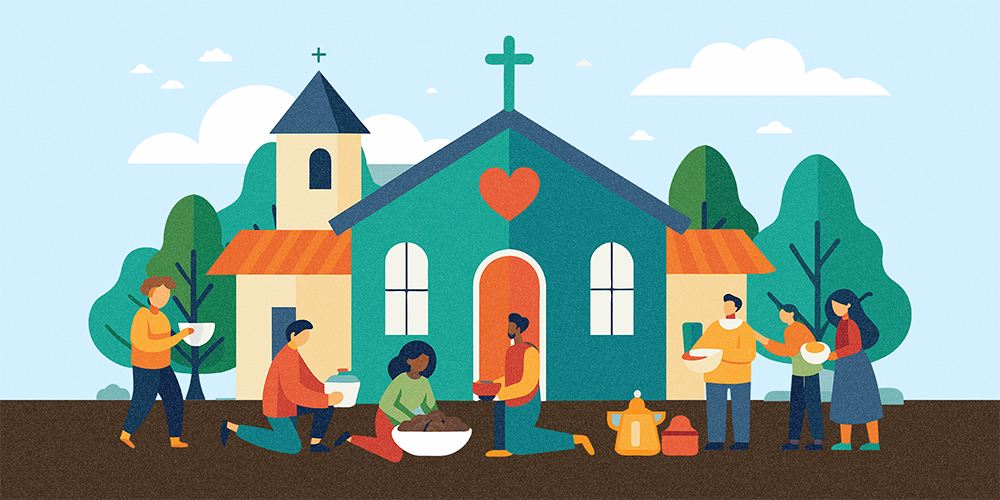
The most consequential decision we ever made as a church was to stop distributing food and to start eating with people. Practicing proximity and mutuality in a weekly Sunday common meal opened up for us the possibility of becoming family. Eventually we decided to take literally Jesus’ words, “Bring in the poor, the crippled, the blind and the lame … so that my house will be full” (Luke 14:21, 23). We became a church where you’re loved when you’re here and you’re missed when you’re gone.
New Ways and Questions
When Scripture is read in that context, familiar passages start to resonate in new and surprising ways. Inclusion of those on the margins brought up new questions: How can we be church together? What makes a church? How can you tell something is a church when you look at it?
_
“We became a church where you’re loved when you’re here and you’re missed when you’re gone.”
We were wrestling with a historical question: What are the marks of the church? Some say they’re scriptural: where the Scriptures are rightly divided. Others say liturgical: where the sacraments are rightly administered. Still others say cultural: where we are connected directly by tradition and lineage to the original Apostles.
But what did those original Apostles say was a mark of the church? When faced with diverse churches and communities and the need to keep a Jesus-centered and cross-shaped coherence to the movement, what did they prioritize?
In Galatians 2:1–9, Paul says he went to Jerusalem to meet with Peter, James, and John so he could present the gospel he was preaching and make sure it was in line with the teaching and practice of the whole church. He went because some were saying you couldn’t be Christian unless you were circumcised. But Peter, James, and John found nothing to add and nothing to change about what Paul was doing. And they didn’t require Paul’s co-leaders to be circumcised. They gave Paul the right hand of fellowship to express the unity between them.
They were willing to give up circumcision as a mark of being a Christian and, therefore, also as a mark of the church. It may not seem like much of a sacrifice to us, but it was monumental at the time.
Circumcision was cultural. It was a way to embody tradition and to trace their lineage back to Abraham. To give up circumcision was to give up one of the most significant cultural markers of the people of God up to that time, and along with it to give up the place of privilege and power within the church for those who were ethnic descendants of Abraham in order to accept as equals those from other cultures.
Circumcision was liturgical. It marked those whom God had chosen as God’s very own and in that way was an outward sign of an inward and invisible grace. It became a rite, with ritual and prayer and liturgy surrounding it. To use our word, it was a sacrament, long established and which many probably felt was the primary sacrament of belonging in the family of God, to which the newer sacraments of baptism and Communion were being elevated in importance. To give up circumcision was to rethink the sacraments and to reorder priorities and worship.
Circumcision was scriptural. In Genesis 17, God appears to Abraham and commands the practice. At first, God says circumcision is the sign of the covenant, but later says circumcision is the covenant. What’s more, God tells Abraham that circumcision is to be observed forever. Forever. That’s Scripture. And it says forever. When does forever stop?
But when the Apostles saw the grace of God at work among the Gentiles, they were willing to let go of what was cultural, of what could outwardly pass as Christian because it “looks like us.” They were willing to rethink worship and the sacraments at their core. And they were willing, not just to reinterpret one scriptural text, but because that one text said, “Forever,” they were willing to reshape their approach to interpreting Scripture and their relationship to the revelation of God.
What they were willing to give up for the sake of unity was significant. It totally redefined what it meant to be the church.
But if what they were willing to give up was so significant, what they weren’t willing to give up was even more important. In essence, they said: You can give up our culture, you can change how you worship, you can even reinterpret sacred Scripture. But there’s one thing you cannot do if you want to be the church, one thing you cannot deny if you want to remain aligned with the apostolic movement, one thing you cannot ignore if you have any hope of maintaining a coherent connection to the kingdom movement that Jesus started. Paul writes in Galatians 2:10 that the one thing “they asked was that we continue to remember the poor.”
Remember the poor. The poor are a mark of the church. Their presence is an indication of faithfulness to Jesus’ ministry and a sign of apostolic succession, one mark of the church they said could not be given up. We cannot call ourselves a Christian community and exclude the poor. If we forget the poor, we risk that nothing we do is “in remembrance of Him.” Cultural, liturgical, and even scriptural differences can be accommodated. But forget the poor, and we’re no longer in line with the historic Christian movement; we’re missing something essential about being the church.
God’s Grace at Work?
Where the poor are rejected, the grace of God has been rejected, and something else is powerfully at work. Acts 4 says of the earliest church that the grace of God was so powerfully at work that there were no needy persons among them, but they cared for one another until all needs were met. The measure of how powerfully God’s grace has gripped a people, from the very first days of the church, has been the generous and effective care of the poor.
_
“We cannot call ourselves a Christian community and exclude the poor.”
God’s grace was so powerfully at work that there were no needy persons among them.
But in many of our churches there are no needy persons among us. And it is not because of God’s grace. But I tell you, where there are no needy persons among us, something is always powerfully at work. Disunity in the church takes hold when we divide space and only bring the poor into certain rooms, ministries, or events. Disunity grows when we divide time and only remember the poor for an hour on Tuesday, or for a Saturday in June, or for that one mission trip a couple of years ago. The result is a church that has become a divided body, where poor members are cut out of “us.”
Is it any wonder that such churches are no match for what is powerfully at work in our society? What is powerfully at work in cities that make no room for the poor to have their needs met among us? Cities that relegate them to the broken-down houses of slumlords and cut their neighborhoods off from the flourishing of the community? What is powerfully at work in cities that pass laws to chase the homeless from their tents and — with the first few dollars they’ve spent on homelessness in a generation — buy bus tickets so the poor will no longer be found among us? Is that God’s grace powerfully at work? Or something else?
I believe we can have the city we desire. But if we reject the poor, we’ll get the city we deserve.
A Different Way of Being Community
In Alton, by God’s grace and favor, a different way of being community is emerging. Alton Mission recently received approval to take possession of a 31,000-square-foot federal building in order to provide a set of curated homeless services.
In partnership with a community development corporation and a behavioral health provider, there will be a job training program, a cafe and bakery for the whole city to enjoy, mental and physical health services, more room for the Overnight Warming Location, and plenty of space for people to connect across lines of difference. It’s a chance to practice belonging and beloved community within the brutalist architecture of a 1970s federal courthouse.
There are many hurdles still ahead, including bureaucratic processes and approvals that have to be completed. But the need for outside support stands out. In God’s own way, the smallest and poorest church in town has been assigned this task. That means this is an opportunity for collective self-determination for those on the margins, where the poor help direct the strategy for addressing poverty and homelessness.
But it is a vision that requires co-creators to make it tangible and operational. We need prayer. We need skilled co-laborers whose hearts are stirred. And we need the generosity of God’s people, in both onetime gifts for renovations and recurring donors for ongoing operations.
This is certainly not the only way to remember the poor, and I hope the Spirit will use these words to help churches embrace the poor who are already among them. I pray our churches will be marked as places where the poor are healed. When that happens, it will be because they are the gathering places of a people who lead with belonging and are driven by that mutual love to pursue justice together.
While each church will discern its own way to engage the mission, to remember the poor can no longer be unique.
+
Great Writing + Discipleship Materials