
By Seth Good
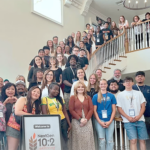
Anyway, the gathering itself was very meaningful. Attendees flew in from across the East end of the country on Friday afternoon and were shuttled from the airport to a nearby hotel to settle in, and then shuttled to Christ Community Church for dinner and an evening message. Pastor Ta’Tyana Leonard spoke Friday evening, encouraging us to consider our journey as disciples of Christ and our meaning in our lives right now.
Disciples Making Disciples
After a good night’s sleep and a hotel breakfast, we returned to the church for a powerful morning session on what it means to be a disciple of the Lord. To summarize this session, a disciple is someone who trains to be like Jesus and makes disciples.
Our entire purpose — our entire reason for existence — is to be a disciple who makes disciples. To do this, we cannot work harder but must give ourselves up to be trained by the Lord. Only He can train us to become mature disciples.
This session carried us to lunch, where we took part in fellowship with each other over barbecue pulled pork and chicken. An afternoon session followed that continued on the meaning of discipleship and dove into our purpose as believers, highlighting the three Great Commandments: love God completely, love others as yourself, and make disciples of all nations.
After dinner, we focused on how we can live out our calling in our own lives. We drew a map of our area and where we can serve, and we followed what’s called a 3-1-4-1 plan to set and achieve serving goals. The 3 in the plan is the timeframe, which can be 3 days, weeks, months, or even years. The first 1 is the No. 1 goal to achieve. The 4 is the logistics of achieving the goal, like who is needed, where and when it will happen, and how it will be performed. The second 1 and last step is to set a first step.
_
“Our entire purpose — our entire reason for existence — is to be a disciple who makes disciples.”
When the plan is set up, it’s important to consider what must be done first. We ended the night with group discussions surrounding these activities, as well as an empowering message to help us get excited about God’s plans for us and to live them out in faith.
Our final night at the hotel passed quickly, and I found myself in a car on the way to the airport. Throughout the weekend, we connected with cohorts of other attendees, which we will continue to meet with over Zoom for the next several months. Overall, the event left me feeling eager to live out my faith, and I’m looking forward to spreading the love of God in my community.
Gen Z and Connectivity
My generation of Christians is distinctly different than others before us due mostly to connectivity. Young adults today know more about global activity than most world leaders have throughout history. We often know more about political figures halfway across the world than we know about our friends in our own backyards.
_
“Overall, the event left me feeling eager to live out my faith, and I’m looking forward to spreading the love of God in my community.”
This constant overload of information can certainly be positive; support for global missions has never been greater, and Christians can reach nearly every part of the world. However, even with this great ability to spread our faith, we often get so distracted supporting communities in foreign lands that we ignore one of the largest mission fields in the world: the United States. In every town, village, and city in this country, there are people who have never heard the Good News and are being ignored because Christians are too caught up in their virtual lives to notice them.
What Gen Z needs is a push — to spend less time online and more time in local communities. However, while it would be easy to condemn Gen Z Christians for their immoderate use of technology, that will only polarize them from older generations and further the issue. What older generations can do is use social media and the internet as a tool to equip and empower young Christians in order to make a difference in their neighborhoods, cities, and states. Several Christian social media influencers are already doing this: Bryce Crawford, Cliffe Knechtle, even Shawn Ryan.
_
“In every town, village, and city in this country, there are people who have never heard the Good News and are being ignored because Christians are too caught up in their virtual lives to notice them.”
What we can do is use the internet for good. We can take a distraction — a source of disconnection from God and discord among believers — and make it something that is used for good. It’s what Christians have been doing for centuries; it’s what Jesus did.
+

Great Writing + Discipleship Materials