
By Ava Flores
“Is discomfort a necessity of obedience? Am I not doing enough if I’m not hurting?”
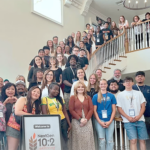
These were the first things I wrote down in my notebook during the opening session of the Next Gen 10:2 Gathering. Gen Zers from the East Coast were invited to participate in a conference at Christ Community Church in Columbus, Georgia, in mid-June, and I had the privilege of traveling down from Rochester with a few others from the Genesis Conference.
The church was incredibly hospitable, and the sessions throughout the weekend were flexible, allowing the Holy Spirit to move amongst us as we explored topics of identity, strength, spiritual gifts, and discipleship. Luke 10:2 was at the center: “The harvest is plentiful, but the workers are few. Ask the Lord of the harvest, therefore, to send out workers into his harvest field.” This prompts the reflection: “Are we so busy possessing the land that we haven’t equipped the next leaders?”
In response, life was poured into us by superintendents and all three bishops as they shared their passion for uplifting the next generation under the Great Commission.
Challenging Assumptions of Ministry Culture
As a recent college graduate, I just finished my first year serving as a resident director at Roberts Wesleyan University, a Free Methodist school in New York. The privilege of your full-time job being in Christian higher education is that your ministry is encouraged in the workplace! It becomes intertwined with your life, and you witness faithfulness, sacrifice, and incredible stories of God’s provision. You also see exhaustion, disappointment, and the quiet expectation that sometimes comes with ministry culture: if you’re serving God well, it should cost you something.
_
“Are we so busy possessing the land that we haven’t equipped the next leaders?”
This is why the lyrics of “I Need You” by Gable Price resonate with me: “Smile with your teeth. Your bruises make a lovely accessory. Have some guts, kid. This is ministry.”
It’s a sarcastic critique of the way suffering in ministry is often romanticized instead of addressed. Burnout becomes evidence of commitment; struggles are hidden behind smiles because people expect leaders to have it all together.
I came to the conference wrestling with whether discomfort itself had become my measuring stick for faithfulness. If ministry wasn’t hurting, was I really sacrificing enough? If obedience felt manageable, was I somehow settling for less than what God wanted?
Throughout the conference, God began challenging those assumptions.
Sharing in Community
As I sat comfortably during an open floor for people to share their testimonies and words, I was pleased to know that my heart wasn’t pounding, a sure sign that God is pulling on you to take the mic. I listened to my peers’ input about how this conference was challenging them and happily supported them from the comfort of my seat. But God’s impeccable sense of humor turned up the heat in my heart, and suddenly my legs were moving to the mic before I could plant myself back down.
I shared my testimony, a story that has been kept to myself, and a story I did NOT plan to share in front of all of those strangers. Out of this vulnerability came tears — tears that I also did not plan to share in front of strangers, and tears that I apologized for letting out. But those strangers brought me tissues, and they cried with me. These weren’t strangers at all; they were a community that shared their love for Jesus with me.
Strength and Dependency
Bishop Kaye Kolde was the first to thank me for my strength in sharing, to wrap me in a hug, and to tell me that I should never apologize for my tears. She told me that our emotions are a gift from God and are meant to be shared with others.
Her words confronted something I didn’t realize I had been carrying. Somewhere along the way, strength had become synonymous with emotional suppression. I believed that faithfulness meant pushing through, staying composed, and carrying burdens quietly. Yet Scripture never portrays godliness as the absence of emotion. The Psalms are filled with lament. Jesus Himself wept.
What if being strong means asking for help? Strength isn’t measured by how much weight I can carry by myself, but how tightly I cling to God and how willing I am to lean on the people He has placed around me. Biblical strength is the ability to cling, hold fast, and remain firm because God is the one fighting the battles. Strength is not self-sufficiency. Strength is dependency.
Trust and Faithfulness
My takeaway wasn’t whether obedience hurts, but rather where my trust is placed. Am I trusting in the vision, the calling, the ministry, the outcomes, or even the sacrifices themselves? Or am I trusting God? God never asks us to glorify our wounds or wear our bruises as trophies. He asks us to walk, cling to Him, and hold fast.
_
“Strength isn’t measured by how much weight I can carry by myself, but how tightly I cling to God and how willing I am to lean on the people He has placed around me.”
I’m grateful for the life that was poured into me by Bishop Kaye Kolde. I understand that I am growing up in a new generation of ministry that gives women the opportunity to hold the mic and cry while doing it. I’m grateful for those who came before me with biblical strength to hold fast, absorbing the bruises of women in ministry so that I don’t have to think twice about my place in it.
_
“I’m grateful for those who came before me with biblical strength to hold fast, absorbing the bruises of women in ministry so that I don’t have to think twice about my place in it.”
Furthermore, I’m grateful for the many hands that prepared the food, created itineraries, and took time out of their lives to give my generation a space to be uplifted in our callings at the 10:2 Gathering. I appreciate my church leaders’ belief in me to fund my trip, and I want to express how much this gathering changed my perspective on strength. Discomfort is not proof of obedience, and suffering is not the goal of ministry. Faithfulness is.
+

Ava Flores serves as resident director and senior coordinator for student life at Roberts Wesleyan University, where she is passionate about helping students navigate challenges, build meaningful connections, and grow into who God has called them to be. A recent graduate of Roberts Wesleyan University with degrees in forensic science and mathematics, she is currently pursuing a master’s degree in strategic leadership. She is a member of Edgewood Church, where she volunteers with the student ministry and enjoys being an active part of the Free Methodist Church community.
Great Writing + Discipleship Materials