
By Evelyn (Evey) Raker
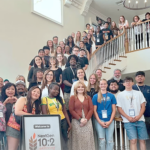
As I was awaiting the Next Gen 10:2 Gathering, I had no idea what to pray for nor what to expect. It was my understanding that I would be spending the weekend with other Jesus-loving young adults for hours upon hours in the church, yet it only took a few hours of being there for me to recognize that this conference was much bigger than that.
As a fairly new Christ-follower, I’ve fallen victim to the misconception that to be a true disciple of Jesus Christ, you must be “Christian enough” and be pursuing a role in ministry. As a young Christian and a future educator, I’ve convinced myself that I am not a true disciple; however, as soon as the conference began, my understanding of discipleship radically changed. Luke 10:2 laid the foundation for the Next Gen gathering, stating, “The harvest is plentiful, but the laborers are few.”
People within our generation are incredibly receptive to hearing the gospel. Our generation is starving for peace and hope in a world that is so broken.
Drawn to the Difference
In my opinion, one thing that sets our generation apart from past generations (and possibly generations to come) is that we recognize the difference in people who have accepted Christ into their life. Instead of turning away from them, we are drawn to them, because they live with an inexplainable peace that brings joy and comfort to our anxious hearts. Our generation seeks after answers and relief, and while Christianity may not provide every answer, it will provide eternal peace.
_
“Our generation is starving for peace and hope in a world that is so broken.”
Not only is our generation receptive to the truth, but those who know the truth are eager to share it. Throughout the gathering, the messages and exercises we received enabled us to gain a firm understanding in what discipleship is and where we can evangelize in our daily lives.
Through these messages and exercises, I learned that to be a disciple is to simply be a learner and a missionary — to learn to be like Jesus and to serve as Jesus served to save the lost. Christians within our generation recognize this calling, but we also recognize that we need the help of older generations to carry it out.
My favorite exercise of the gathering was called the “3-1-4-1.” Before completing this exercise, we drew maps of places in our lives where we want to see salvation taking place. After settling on a specific area, we used the 3-1-4-1 Plan to create a goal for impacting that environment.
Whether those goals were to create something big, like a young adult Bible study, or something small, like placing a prayer journal in a local coffee shop, these goals all had one thing in common: They started with coming to those who disciple us. For example, to start a Bible study, we need permission from our pastors; to set up the prayer journal, we need confirmation from the shop’s owner. We always need God, but to achieve these goals, we also almost always need you.
Many are familiar with John 15:5, “I am the vine; you are the branches. If you remain in me and I in you, you will bear much fruit; apart from me you can do nothing.”
Intergenerational Work
The purpose of our generation is not to be the Lord of the harvest; it is to be laborers. Apart from God, our labor is fruitless. Similarly, apart from the wisdom and mentoring of older generations, our work may not be started.
We ask older generations to, most importantly, keep pursuing the Lord and to also recognize that they play a vital role in our calling as a generation. Because of you, we know the gospel.
_
“The purpose of our generation is not to be the Lord of the harvest; it is to be laborers. Apart from God, our labor is fruitless.”
My favorite words from this conference were “the gospel came to you on the way to someone else.” It is our generation’s calling (and the calling of all children of God) to be disciples who make disciples, living for God’s purpose above our own.
+

Great Writing + Discipleship Materials