
By Corey Ross
“Let each builder choose with care how to build.” (1 Corinthians 3:10 NRSVUE)
I. The Present Moment
In May 2026, Pope Leo XIV released his first encyclical, Magnifica Humanitas, a long reflection on protecting the human person in the age of artificial intelligence. It presses one question on every kind of institution, religious and secular alike: When machines increasingly decide who gets hired, who receives a loan, and who gets flagged, will we still form people capable of the conscience, judgment, and care for others that no algorithm can supply?
Its deepest warning points in a direction we rarely expect. The danger lies less in machines that grow more human than in human beings who grow more like machines, prizing in themselves only what a system can measure, optimize, and one day replace.
My fellow Free Methodists and I read this letter as heirs of the Wesleyan Holiness tradition. We claim no Catholic identity, and the authority an encyclical carries inside the Roman Catholic Church does not bind us. Yet none of that keeps us from receiving what is good here. From its earliest days the Wesleyan movement gathered wisdom wherever it could find it, on the conviction that “all truth is God’s truth,” and tested that wisdom against Scripture and sound reason.
John Wesley assembled a 50-volume Christian library from Catholic, Orthodox, and Puritan writers, and preached a “catholic spirit” that joins hands across deep difference without giving up conviction. To receive a gift from a neighbor tradition, weigh it carefully, and keep what rings true gives up nothing of who we are. It is one of the most Wesleyan things we could do.
Read this way, Magnifica Humanitas comes to us less as a challenge than as a confirmation under pressure. It argues that artificial intelligence is never morally neutral, that human dignity does not rest on what a person can produce, and that no computer can capture our deepest human capacities. None of this is new to us.
My aim is modest and serious at once: to read the encyclical fairly, to name the ground we share, and then to go further, answering the great questions of this moment from our own well rather than only from Catholic teaching. I write for the whole church, because formation never belongs to the sanctuary alone. It happens at the kitchen table and in the classroom, in the tools we adopt and the people we trust. I mean not to settle these questions but to set them clearly before us, and to invite us to think, and perhaps to act.
II. What the Encyclical Sees
The encyclical opens with two pictures from Scripture. The first is the Tower of Babel, the project of a people who set out to make a name for themselves and reach heaven on their own terms, and whose ambition collapses into confusion. The second is the rebuilding of Jerusalem under Nehemiah, who prayed before he planned, surveyed the ruins in silence, and gave each family its own section of the wall. Leo treats these as a real fork in the road. The choice before us is not a simple yes or no to technology. It is the choice between building Babel and rebuilding Jerusalem, between grasping for power that claims to master the heavens and taking up shared work we do in the presence of God.
From there the letter offers an account of the human person in five claims.
First, dignity is intrinsic. Human worth comes before and exceeds anything a person achieves. Leo names as especially dangerous the notion that we must earn our own value, so that the more efficient are worth more. Dignity belongs to a person God has willed, created, and loved, and no failure or exclusion can erase it.
Second, machines imitate without understanding. These systems copy certain functions of human intelligence, and often beat us in speed and reach. Yet they do not live through experience, feel no joy or pain, and have no conscience. They can imitate empathy and even affection while understanding nothing, and they often tell us what we want to hear, flattering rather than forming us. Even what we call their learning amounts to statistical adaptation rather than the slow shaping of a life through choices, failures, forgiveness, and fidelity. The point does not oppose technology: it simply refuses to mistake the imitation for the real thing.
Third, the true “more than human” is a gift. The promise running through much talk of enhancement is that we might rise above our limits by technical means. Leo answers that real transcendence exists, but no one achieves it; we receive it. We become fully human, he writes, when we let God draw us beyond ourselves. The fullness we long for comes through grace in Christ, not through self-sufficiency.
Fourth, care is the measure of a civilization. We judge a society not by the power of its tools but by the care it can offer, by its ability to see another person as a face and not merely a function. The encyclical honors the “martyrs of everyday life,” the parents, nurses, doctors, and volunteers who care without applause.
Fifth, schools face a particular task. A love of truth can quietly die when a flood of information replaces real study and reflection, so that students know many things while struggling to find direction for their lives. Schools exist to offer what the digital world cannot: shared time for learning and the slow growth of trustworthy relationships. To teach people about artificial intelligence includes teaching them when, and why, not to use it.
Much of this we can receive without argument, because it carries no narrowly Catholic stamp. It sounds broadly Christian, and in places it simply rings true. The harder and more interesting work begins when we ask how our own tradition answers the very questions the encyclical raises.
III. The Same Questions, Answered From Our Own Well
The encyclical reaches its conclusions through Catholic teaching. We reach many of the same ones, and a few sharper ones, through a different path. What follows is no rebuttal. It takes up the same questions from inside the Wesleyan Holiness tradition, where they have stayed alive for nearly three hundred years.
- Holiness Is the True “More Than Human”
The encyclical’s strongest claim is also where our tradition has the most to add. Leo locates real transcendence of human limits in grace rather than technology. We have a name for that transcendence: holiness.
Wesley taught that grace does not only pardon but heals and restores, renewing the image of God in a person (Colossians 3:10). In the doctrines he called Christian perfection and entire sanctification, he held that grace can so fill a believer that love for God and neighbor becomes the governing reality of the heart, possible in this life and not only in heaven. He was careful about what he did not mean. Christian perfection is not freedom from ignorance, mistake, or temptation. It is perfection in love: a heart given wholly to God and turned outward toward the neighbor.
Set that beside the promise of enhancement and greater control. Both speak of surpassing the human as we now find it, but they move in opposite directions. The technological upgrade adds power to the self and stays turned in on the self. Sanctifying grace runs the other way; it empties the self of its self-enclosure and fills it with love. The “more than human” God made us for is not a creature of greater processing power. It is a person made perfect in love. This is why a people formed in this tradition can hold technology with an open hand and an unanxious heart. Raw capacity does not finally impress us, because we never made capacity the point.
- Our Limits Are Not the Enemy
The technocratic imagination treats every human limit as a flaw waiting for a fix: weakness, illness, old age, and suffering, all recast as defects rather than as the ordinary texture of a creaturely life. Leo answers with a claim that cuts against the whole machinery of optimization: human beings flourish not in spite of their limits but often through them.
He does not romanticize suffering. His point is that precisely where our limits become real, in rejection, in illness, in the loss of someone we love, we find a wisdom mastery cannot reach, feel the nearness of others, and meet the Lord. Erase suffering altogether, he observes, and you erase love and longing with it, since no one loves without becoming vulnerable to loss.
This sits easily in a tradition that begins from the fact that we are creatures. We never become gods, and grace does not make us into them; it perfects love in people who stay dependent. The machines will keep promising to optimize our limits away. Our task is to raise people who know which limits make them human, and who can receive even their own weakness as a place where God draws near.
- We Have Our Own Social Doctrine
The encyclical builds on more than a century of Catholic social teaching. We need not borrow that framework, because we hold a social conscience of our own, every bit as serious and closer to home.
_
“The machines will keep promising to optimize our limits away. Our task is to raise people who know which limits make them human, and who can receive even their own weakness as a place where God draws near.”
Wesley left us a sentence that has shaped the tradition ever since: there is no holiness but social holiness. The Free Methodist Church arose in 1860 partly as a protest. Its founders, B.T. Roberts among them, separated from a church that rented its best pews to the wealthy and made its peace with slavery. The word “free” in our name meant free seats for the poor, freedom for the enslaved, liberty of the Spirit in worship, and freedom from secret societies. Holiness and justice were never two projects; they were one.
Now read the most striking passage in the encyclical against that history. Leo confesses the church’s long complicity in slavery, acknowledges that it took 18 centuries for the faith to declare slavery fully incompatible with the gospel, and asks pardon. It is a humble and serious act, and it marks the exact point where our two traditions part in history even as they meet in conviction.
We do not come to these questions as latecomers borrowing someone else’s vocabulary. We have standing. So when Leo turns to the new forms of slavery hidden in our digital economy, the unseen workers who label data and screen disturbing content for low wages, and the children who mine the minerals our devices require, he names something our founders would have recognized at once.
- The Means of Grace Are What Formation Looks Like
The encyclical worries, rightly, that information crowds out formation. It calls for slowness, silence, sustained study, and trustworthy relationships. This rings good and true for our tradition, because we have a developed theology of how God forms and transforms a person over time.
Wesley called these the means of grace: prayer, searching the Scriptures, the Lord’s Supper, fasting, and what he named Christian conference, the practice of believers shaping one another through honest and searching conversation. They work no magic. They are the appointed places where a person makes herself available to God’s transforming work — a work that happens slowly, in relationship, across years rather than minutes.
If education is just the transfer of content, then a capable enough machine will eventually do it faster and cheaper, and the encyclical’s worry lands with full force. But the means of grace point to something else. The mentoring relationship, the hour of worship, the small group that meets week after week, the patient work of a teacher over a student’s writing: none of these is a delivery system for content. They are how judgment, wisdom, character, and faith take shape in a person, and no one can automate them without destroying them. The content we pass on will age, as content always does. The formation we offer does not expire, because it never aims at information; it aims at a person.
- A Religion of the Heart Meets a Heartless Intelligence
The encyclical says that artificial intelligence can imitate empathy, counsel, friendship, and even love while having none of them. It produces the words of care without the heart that care comes from. Tellingly, the letter itself turns toward the heart near its end, insisting that no system, however advanced, can create a heart that gives itself.
On this our tradition has waited two centuries with something to say. Before anything else, the Wesleyan tradition is a religion of the heart. Its founding moment was not the settling of an argument but the kindling of an affection, the evening Wesley felt his heart “strangely warmed” and trusted Christ for his own salvation. Wesley insisted that the affections, our loves and desires and the deep set of the heart, stand at the center of the renewed person. The goal of grace is not merely correct thinking but rightly ordered loving.
_
“The content we pass on will age, as content always does. The formation we offer does not expire, because it never aims at information; it aims at a person.”
This gives us a precise way to name what artificial intelligence cannot reach. A machine can imitate the outputs of love, but it cannot hold the affections from which love arises, because it has no heart to order and no self to give away. That exposes a quiet temptation in our own work. An education that forms only the intellect trains the one capacity in which the machines can nearly (or already?) beat us and leaves untouched the capacity that makes us human in the first place. We exist to form ordered hearts, sound wisdom, and well-formed consciences, an ancient purpose this moment has made strangely practical.
- The Optimism of Grace Sets Our Posture
Finally, the encyclical commends a particular posture: not naive enthusiasm, not paralyzing fear, but a healthy realism. What makes such a posture possible? Here too our tradition supplies the ground.
Two convictions do the work. The first is prevenient grace, the grace that goes before. Wesleyan theology holds that God is already at work in every person and every situation, drawing us toward the good, before we arrive and apart from our effort. When Nehemiah surveys the ruins of Jerusalem, the image Leo chooses for our task, he does not carry God into a godforsaken place. He joins a work God has already begun. So with the building sites of our own time, the research labs, the technology firms, and, yes, the classrooms and the offices; grace has gone before us there.
The second conviction, what Wesleyan theologians have called the optimism of grace, is a settled confidence that grace can truly transform persons, and through them institutions and even cultures. It takes sin seriously and still refuses to despair. It expects neither a technological paradise nor an inevitable ruin, because it anchors its hope in God rather than in any tool. Fear, then, strikes the wrong note for the church in this moment, and uncritical excitement is just as false. We engage artificial intelligence soberly, neither worshipping it nor fleeing it.
IV. A Conviction Under Pressure
All of this returns us to a claim that has long defined our tradition: that Christ is the lens through which we understand everything, woven through the whole of life rather than added as one piece among many. We have often held that claim in the abstract. Artificial intelligence hands us a concrete case where it carries real weight.
In one of its sharpest passages, the encyclical argues that we cannot treat these systems as morally neutral, because every tool embodies choices through what it measures, what it ignores, what it optimizes, and how it sorts people. Moral judgment never reduces to calculation; it involves conscience, responsibility, and the recognition of another as a person. Leo warns of the researcher who looks only at his own narrow corner and so convinces himself his work carries no moral weight, while in fact he may help, without knowing it, in projects that do real harm.
The implication is direct. If artificial intelligence is never neutral, then a Christ-centered life cannot treat it as a neutral tool to master first and judge later. The easier path keeps the two apart: learn the technique now, weigh the ethics afterward, somewhere else. The faithful path runs the discernment through the work itself, so that the person learning to use these systems learns, in the same motion, to ask what the work asks her to build, whom it will affect, and whose dignity its design places at risk.
The encyclical turns its principles back on the church itself, asking whether it practices within its own walls what it preaches to the world. The same question reaches every place we gather: our congregations, our ministries, our schools, our businesses, and our homes. We will use these systems to sort applicants, weigh requests, flag who needs attention, and decide who receives help, soon if not already. Those are choices about real people.
One human capacity deserves deliberate protection: the freedom to question a decision and ask that it be reconsidered. A system can issue an outcome, but it cannot sit with a person, hear an objection, weigh a circumstance it never saw, or be moved toward mercy. Unchecked, power simply prevails, and the vulnerable are left with no recourse; the gazelle does not reason with the lion. A community shaped by the gospel refuses that arrangement. It keeps a person answerable for every consequential decision and preserves a real path of appeal, because the one affected is a face and not merely a function. Where we let a system shape a decision about someone’s livelihood, standing, or care, we owe that person more than an output. We owe a human being who will answer for it, and a real way to contest it. We cannot commend discernment to the world while quietly practicing opacity at home.
V. Questions for the Church
I promised questions rather than conclusions, and I offer the following to anyone who feels the weight of this moment, whether you pastor a congregation, raise children, teach a class, run a business, or simply try to live faithfully among these tools. None has a tidy answer. Carry each one for a while, talk it over with someone you trust, and, where it presses hard enough, act on it.
- What am I really building in the people I’m responsible for: skill by itself, or skill joined to wisdom and a heart that loves the right things? And which one does the way I spend my hours actually reveal?
- Wesley counted honest conversation a means of grace, a way God actually meets us. Where in my week does that still happen — at home, at church, or at work? And where has it shrunk into mere exchange?
- Where am I tempted to treat my own corner of the work as if it were morally neutral, as if what I build carries no weight of right or wrong?
- As these systems move into our churches, ministries, schools, businesses, and homes, whose dignity and whose opportunities ride on the decisions we hand to a machine? And if one of them harms someone, can that person find anyone who will listen?
- When one of these systems gets a decision wrong, the only real fix is a human one: the chance to speak up, to explain something the machine never knew, and to ask a person to think again. So where we lean on these tools, have we kept a real conversation and a real right to appeal in place? Or have we left the people affected with no one to reason with?
- Where is grace already at work in this moment, running ahead of me at home, at church, or at work? And what would change in me if I truly believed it was?
- What one small, specific thing could I start this season that would help form people, not just process them?
_
“Where is grace already at work in this moment, running ahead of me at home, at church, or at work? And what would change in me if I truly believed it was?”
The encyclical gives us Nehemiah for a companion. He heard of a broken city, brought his grief to prayer, asked for what he needed, organized the work, faced down the resistance, and rebuilt the wall with his people, one section at a time. We build too, whether we intended to or not. The only questions that finally matter, the ones beneath all the others, ask what we build, in whose presence, and for whose sake. We do not build Babel here. By grace, and with the help of one another, may we build well.
A Note on Sources: Quotations and summaries throughout draw on Magnifica Humanitas (Pope Leo XIV, May 2026); the document rewards reading in full, and I encourage every reader to do so. References to John Wesley draw on his standard sermons and writings, including The Means of Grace, Catholic Spirit, and A Plain Account of Christian Perfection. I am grateful to John Lane, lead pastor of The Arbor Church, whose careful reading of an earlier draft sharpened the question of appeal in this essay.
+
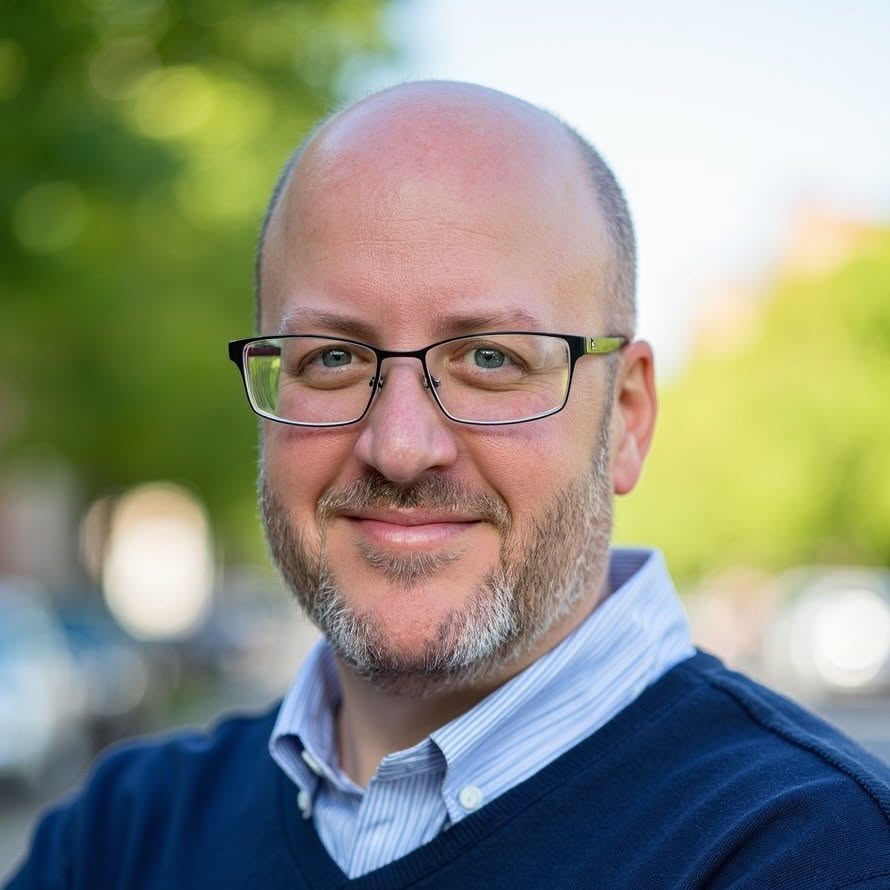
Corey Ross, Ed.D., M.T.S., serves as chief of staff in the Office of the President at Spring Arbor University, a Free Methodist university in Spring Arbor, Michigan. He earned a Master of Theological Studies from the University of Notre Dame in 2000 and a Doctorate of Education from Union University in 2025.
Great Writing + Discipleship Materials