
By Ethan Goodnight
“I have here the original, authentic, first-century fishing net used by Simon and Andrew,” J.D. Walt announced, with a twinkle in his eye, pulling a rough, small brown net from his backpack. Holding the net up for all to see, Walt explained how the net is to him the greatest image for the church in Scripture: a collection of knots, woven together by Jesus, to turn His followers into fishers of people. And what are the knots? Discipleship bands, intimate friendships of three to five men or women following Jesus together.
As president and “sower-in-chief” of Seedbed, J.D. Walt is now 20 years into a 50-year vision to resuscitate the storied Methodist practice of banding throughout the United States and the world. Bands, revitalized for our 21st century world, offer something desperately needed in a country where loneliness has reached epidemic proportions: intimate friendship.
Walt’s thesis is that the church has more of a connection problem than a content problem: “The reason we get stuck is that we lack relationships that sustain transformation,” he explained. Bands provide the place for these relationships to grow, allowing a series of small risks and steps without pressuring people into immediate vulnerability or accountability. The key calculus from Walt is simple yet profound: “Time + Trust = Transformation.”
This year, Seedbed’s New Room Conference called the church to “Band Together.” Hosted at the newly Free Methodist Frazer Church in Montgomery, Alabama, and attended by nearly 2,000 people, New Room Conference leaned into this vision from the beginning. I attended New Room with two bandmates: one coming from Chicago, the other Connecticut, and myself from Massachusetts. Upon walking into the conference with two bandmates, we were prompted to pick a certain-color lanyard based on whether we were currently in a band or not. Let the practice of forming new Christian friendships begin!
As the conference progressed, each keynote speaker and many of the lab sessions brought a new dimension and word of wisdom to the banding practice. Main sessions, now available to purchase and stream online, began with testimonies from leaders and laity about the impact Banding Together has had in their lives. For many, bands saved their lives.
Dr. Kevin Watson, associate professor at Asbury Theological Seminary, testified about a vulnerable moment in his life at seminary when a group of men took him in and banded together. Without their intervention, he doubted he would have finished his schooling. The power of God through their friendship sustained Watson and inspired him to write his doctoral dissertation on Methodists bands, a subject he continues to pursue today.
_
“Let the practice of forming new Christian friendships begin!”
As J.D. Walt explained in the opening keynote, the theological foundation for the banding movement is Jesus. We see Jesus in three bands: Band #3 is Peter, James, and John. These are the men with him on the Mount of Transfiguration and in the Garden of Gethsemane. Bands are with you in the highest highs and lowest lows. Band #2 is with Moses and Elijah, transfigured. But, most foundationally, we have at the very bedrock of our faith Band #1: the Trinity — Father, Son and Holy Spirit, one God in three Persons. The original band, if you will.
Vertical and Horizontal Bands
Two of the keynote speakers invited us into this “vertical band” with God as the basis for our “horizontal bands” with others. Bishop Kyle Searcy of the Fresh Anointing House of Worship and Dr. Amy Orr-Ewing urged us to draw close to God as the source of hope and identity. As Orr-Ewing exposited from Exodus 3:11, when Moses asks God, “Who am I?” God responds not with a name or identity but with His presence: “I will be with you.” To a world isolated and alone, the presence of God with us, Emmanuel, is our greatest loving response. And it comes predominantly through intimate friendships, with God and fellow believers!
Two other keynote speakers delved deeply into the “why” of bands for Christians. Noted author Andy Crouch offered the single best explanation of the limits and potential of technology and artificial intelligence this millennial has ever heard. Jesus and His first followers, Crouch explained, were quite ambivalent to the technology of His day, relying instead on the power of loving human connections and sacrificial presence. This is the fertile ground for human formation, not AI chatbots that are incapable of fruitful behavior and sacrificial presence. “Unlike ChatGPT, God doesn’t usually answer when prompted,” Crouch quipped to peals of laughter. Rather, God can be present, silent, and love us without answering back, much like Job’s friends (before they screwed it up) and much like loving Christian bands can be.
The most emotionally moving talk was delivered by author and Pastor Luann Riley who shared vulnerably about a years-long wilderness season she endured: three years with an unending migraine. She shared tearfully of the community of close friends who banded together to love her through that season, and she offered a stunning exposition of Elijah’s wilderness season, revealing how “anointing does not eliminate limitation.” “Scripture does not hide the depths of despair that faithful people experience,” she explained, warning us that holding things together for God usually leads to holding things back from God.
Elijah’s “I’ve had enough” prayer (which maybe some of you reading this have prayed yourselves) brought him to the end of self-sufficiency and the beginning of God’s tender care. Weaving her story and exposition together, Riley warned us of trying to go at it alone, encouraging us to be cared for by God, often through our friends and bands.
The Knots of the Net
Jon Thompson closed the conference with a prophetic word for the church: Bands are the knots of the net that God wants to throw into the world. Walking through the stories of Jonah, Daniel, and Levi (Matthew), Thompson articulated a profound series of stress tests for our faith.
_
“Elijah’s ‘I’ve had enough’ prayer (which maybe some of you reading this have prayed yourselves) brought him to the end of self-sufficiency and the beginning of God’s tender care.”
First, do we believe “those people” are even deserving of the Good News? Jonah certainly did not! But God’s mercy broke Jonah’s understanding of God’s justice as a thing limited to one nation.
Second, it’s one thing to go and preach; it’s another thing to stay. Daniel was called to be a blessing in the middle of paganism. We too need permanent, loving presence in our communities today.
Third, there’s a difference between living “among” people and living “with” people. Jesus didn’t just live among sinners; He called Levi, a Roman collaborator, to follow Him, and He went and ate with him and his friends. Are we willing to be in loving relationship with those who are the furthest from who we are?
This Christ-centered approach to life is not about safety. It’s about truth and holiness, Thompson exhorted us. And it can’t be lived alone.
Belonging Together
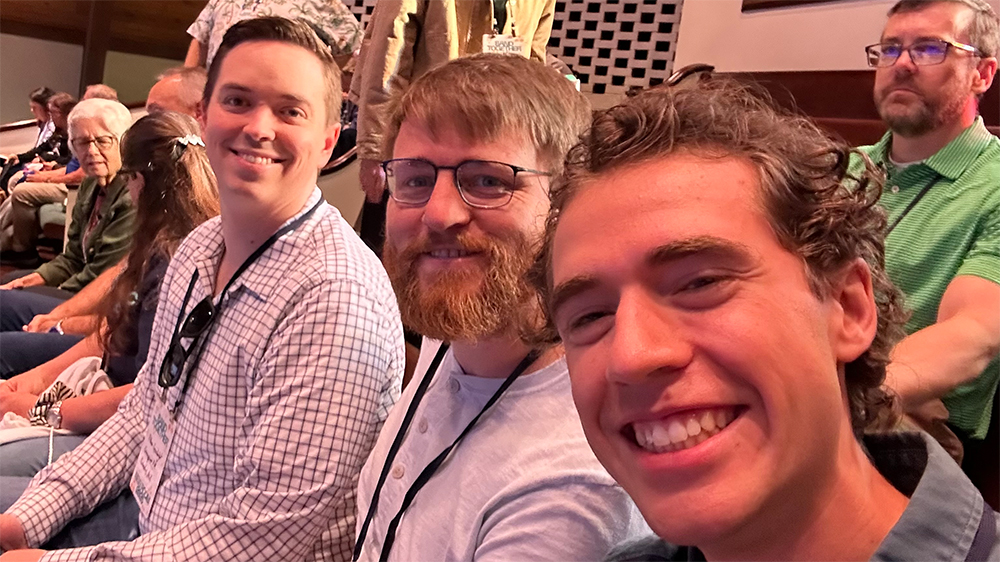
I was able to attend this conference with two of my own bandmates, Peter and Dylan. We enjoyed beautiful times of conversation and worship together.
The conference affected us in different ways. It was restorative to me; revealing and resurrecting to them. But all together it reinforced the profound truth of Paul in Romans 12, “in Christ we, though many, form one body, and each member belongs to all the others.”
We left with renewed hope that time spent together in the presence of God, cultivating trust, provides the best path to sustained transformation into the image of Christ.
+

Ethan Goodnight, Ph.D., is the associate pastor of GracePoint Church in Chelmsford, Massachusetts, and a conference ministerial candidate (CMC) in the Acts 12:24 Churches Conference. He is married to Maria, a high school Spanish teacher, and they have two children: 4-year-old Russell and 1-year-old Miriam. He also serves on the Friends of Immanuel Board and the Free Methodist History and Archives Committee. Ethan holds a Doctor of Philosophy degree in American studies from Harvard University, a Master of Arts degree in the social sciences from the University of Chicago, and a Bachelor of Arts degree in history and philosophy from Spring Arbor University.
Great Writing + Discipleship Materials