By Robyn Florian
“Hope returns when I remember this one thing: The Lord’s unfailing love and mercy still continue … The Lord is all I have, and so in him I put my hope.” (Lamentations 3:21–24 GNT)
Hope returns when we remember.
That belief lies at the heart of what I have come to call The Hope-Brained Way — a way of walking with God on the deeper way through brokenness toward reconciliation, repair and resilience.
In Part 1 of this series, I invited us to consider the wilderness way from immaturity to maturity, brokenness to wholeness, surviving to thriving and languishing to flourishing. In Part 2, I suggested that four familiar Christian practices — read, pray, meet and serve — might become more than items on a spiritual checklist. Practiced as hope-brained rhythms and understood as a journey, they offer a well-traveled way of walking with God:
Remember God’s Story (Read)
Recover Our Stories in Christ (Pray)
Relate Our Stories in the Church (Meet)
Reveal God’s Story in the World (Serve)
My pursuit of this Hope-Brained Way began during my doctoral study at Asbury Theological Seminary as I wrestled with a call to “better equip the church to walk with people in crisis and brokenness” by reinterpreting brokenness. Scripture tells us we are “called to one hope” (Ephesians 4:4), but I found myself wrestling with how we hope, how we restory our destoried stories. How does God actually meet us in brokenness, reframe the meaning of our pieces of brokenness and beauty, and restory us into people increasingly capable of living lives of hope reflecting the grace and truth like Jesus, from faith in a Father’s love and for love of others in the world by the presence, power and providence of the Holy Spirit?
That question led me to explore the intersection of Scripture and theology with attachment, neuroplasticity and narrative therapy. My research also led me to John David Walt’s “Second Half of the Gospel” sanctification milestones on the journey toward Christian maturity — discontent, descent, dependence, delight and devotion.
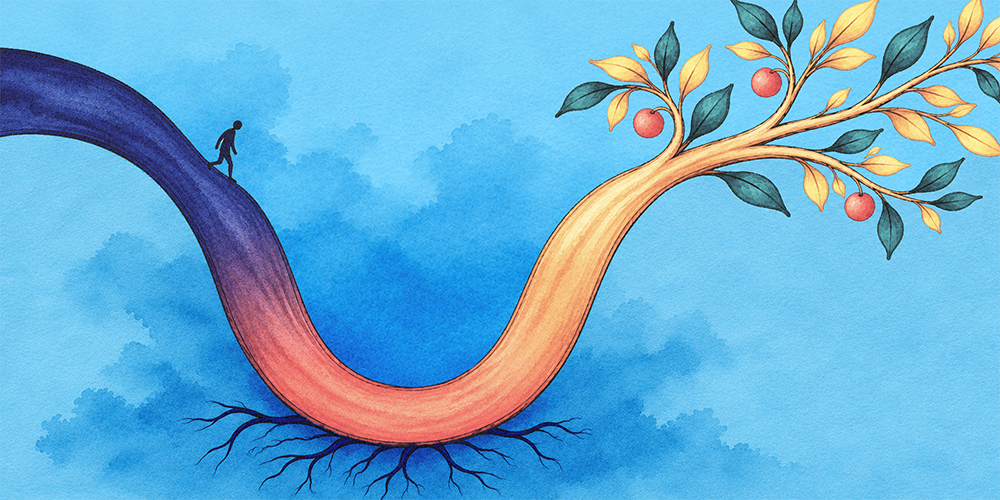
Walt describes this deeper work from first-half justification to second-half sanctification as “down is the new up.” I began to recognize a similar movement within the Hope-Brained Way: reparative formation moved inward and downward before shifting to upward and outward.
Walt’s oft-refenced movements of revelation, consecration, proclamation and demonstration gave me additional hope-brained language regarding the means of a transformational whole-brained and co-brained way of walking with God and others.
I have a 400+-page dissertation on The Hope-Brained Way of resourcing restory, which I’d love to share with you, but perhaps the simplest way I know to explain it is to pray it.
Abba Father, I thank You for Your truth. I pray that we might becoming increasingly attached to You as we abide in Your Son, Jesus, with the agency You have given us by Your Spirit.
Remember: God for Us
In seasons of holy discontent — when shame, pain or brokenness disrupt the story of a Father’s love in our spirits — I pray for Your revelation as we remember Your story, accessing and absorbing Your truth; engaging Your Word by contemplating Your words.
This is the soil space of hope.
Before we can reinterpret our stories, we need a larger Story capable of holding them. Scripture supplies the nutrient-rich ground in which hope takes root. God’s Story comforts, convicts and captivates us, reminding us who He has always been and reorienting us toward a Father who loves us and wants us in His family.
Hope begins by remembering what is true.
_
“Scripture supplies the nutrient-rich ground in which hope takes root.”
Recover: God in Us
As hope begins to take root in truth and You draw us deeper in our experience of who we are in You, with all our beauty and brokenness, I pray for our consecration as we recover our stories in Christ, acknowledging and appraising our stories according to Your truth; engaging Your will for our lives by contemplating Your voice.
This is the personal root space of hope.
Here we prayerfully entrust our identity to the rootstock of Christ, becoming increasingly grafted into His character. Rather than hiding from the wounded places of our stories, we approach the grace of Jesus with curiosity, trusting a Son and Savior who works in us to infuse us with truth and mend our brokenness with His wholeness.
This is difficult, downward work leading to the deep and often dark place of dependence, the crux of surrender and submission, trust and obedience. In this deep place, God regenerates what has been wounded, reframing identity and inscribing His truth on our souls. It is here where we gain a better understand of God’s calling for our individual lives and the plans He may be working in us.
The inward, downward way of new information in Scripture and new personal experiences with Jesus prepares us for the outward, upward way of new understanding in community with believers and new meaning in the world. Often this deep place of repair proves a catalyst to new growth. Here the story shifts.
Relate: God Among Us
In light of this promised repair and renewal, I pray for our proclamation as we relate our stories in Christ together, assessing and activating Your truth in the church, engaging Your work by reflecting Your face to one another; delighting in our shared intimacy with Christ.
This is the relational shoot space of hope.
Individual growth flourishes in corporate fellowship, where our new identity in Christ working among us encodes a renewed personality in community with other believers. Here the body of Christ learns to walk confidently in the truth of Jesus’ purpose for His church.
Here we learn that Christian maturity is not about independence but interdependence. We practice truth and grace with actual people. We grow in our capability to trust, confess, forgive, encourage, repair and remain. The body of Christ learns to live into Jesus’ purpose for His church, tending to the bonds of kindred belonging for the sake of kingdom building.
Hope becomes something we hold together.
Reveal: God Through Us
Finally, we look for Your comfort and conviction, curiosity and confidence to love with courage, bringing forth Your demonstration as we reveal Your story through our stories, announcing and animating Your truth in Your kingdom; engaging the world by reflecting Your tangible presence; devoted to loving others by the power of the Spirit.
This is the promising fruit space of hope.
As we move into the world, may the presence, power and providence of God’s Spirit overflow through His people as we embody the love of Christ in the world. This is where the reconciliation, regeneration and redemption we have received becomes restoration we can extend to others. Hope bears fruit beyond itself through lives of faithful service, action and compassion.
We do not simply tell the world that God restores. Increasingly, by His Spirit, our lives become part of the demonstration. As Walt states, “When the church wakes up to the second half of the gospel, the world will wake up to the first half of the gospel.”
And so the Hope-Brained Way becomes a repeating movement of grace:
Remember God’s Story (Read for Revelation)
Recover Our Stories in Christ (Pray for Consecration)
Relate Our Stories in the Church (Meet for Proclamation)
Reveal God’s Story in the World (Serve for Demonstration)
_
“We do not simply tell the world that God restores. Increasingly, by His Spirit, our lives become part of the demonstration.”
God reconciles us to the foundation of hope as we encounter His love in Scripture. He regenerates and redeems us in a foundry of hope as we experience the grace and truth of Jesus reshaping us. And He restores us as a fountain of hope, enlivened by the presence, power and providence of His Spirit overflowing through us toward others.
Prayer
Abba Father, continue to reveal to us who You are, who we are in You, exactly what You have called us to do and whom You have called us to lead. Make us secure foundations, safe foundries and proximal fountains — people who make a way and a space for others to restory their stories because You have made a way and a space for us to restory ours.
In the name of Jesus and by Your Spirit. Amen.
In a future Light + Life article concluding this series, we’ll consider where this journey is taking us: toward the maturity of holy love — from coping to hoping, from straining and striving to surrendering and submitting, and from grasping to receiving.
+

Robyn Florian, D.Min., is the director for alumni relations at her undergraduate alma mater, Greenville University. She also serves the Free Methodist Church as a member of the Gateway Conference’s MEGA (Ministerial, Education and Guidance, and Appointments) Board. She previously led Greenville University’s public relations and marketing efforts for 12 years before entering her own season of wilderness wandering and wondering through experiences in prison ministry, disaster relief, homeless care and those dealing with medical crises. This journey led to the development of The Hope-Brained Way: Reinterpreting Brokenness Through Reparative Restory via Trauma-Informed Spiritual Formation (hopebrained.com). She has Master of Arts degrees from Regent University (communication: digital engagement) and Liberty University (Christian ministry) and a Doctor of Ministry degree in organizational leadership from Asbury Theological Seminary.
Great Writing + Discipleship Materials