
By Carl Brannon
“Remember this: Whoever sows sparingly will also reap sparingly, and whoever sows generously will also reap generously. Each of you should give what you have decided in your heart to give, not reluctantly or under compulsion, for God loves a cheerful giver. And God is able to bless you abundantly, so that in all things at all times, having all that you need, you will abound in every good work.” (2 Corinthians 9:6–8)
In the North Central Conference, we have been working hard to create a new culture for the past five years. I have tried to tap into every resource possible to awaken a call to multiply disciples, leaders, and churches, and we have seen incremental movement and growing momentum.
But I was becoming increasingly aware that we need more than just vision casting, training, equipping, and coaching. We need a collective heart shift. We need to work together more and to demonstrate something different. Isolation, mistrust, cynicism, fear, and prejudice lie under the surface of our world today.
A Liturgy of Generosity
One day I was watching a YouTube video of a service at Church of the City, New York. At the offering time, they didn’t fumble through an apologetic “Thanks for your generous support … no pressure if you are a guest. There’s a box in the back or a QR code on the screen…”
_
“We need a collective heart shift. We need to work together more and to demonstrate something different.”
They read a liturgy of generosity:
Holy Father,
There is nothing I have that You have not given me.
All that I have and am belong to You,
bought with the blood of Jesus.
To spend everything on myself and to give without sacrifice,
is the way of the world that You cannot abide.
But generosity is the way of those who call Christ their Lord;
who love Him with free hearts
and serve Him with renewed minds;
…Above all, I am determined to be generous
because You, Father, are generous.
It is the delight of Your daughters and sons to share Your traits,
and to show what You are like to all the world.
Amen.
In a day and time where most of the church barely mentions tithing or giving financially out of fear, Church of the City recites this liturgy of generosity every week. Something about this liturgy inspired me.
In a world where there is so much emphasis on saving, building up wealth, and protecting what is ours, this emphasis comes from a church made up predominantly of young adults seeking a fast-track to power and success.
But it’s not just about money. It’s about hospitality. It’s about faith. It’s about living out the teachings of Jesus in a countercultural lifestyle that seeks the good of others.
Sunflowers: Heliotropic Hyperaccumulators
Then I was introduced to the mystery of sunflowers.
My mother loved sunflowers. She was a Kansas farm girl, and the sunflower is the state flower of Kansas. I first saw sunflowers, particularly fields full of sunflowers, on trips to Kansas, but that’s not why I’m discussing sunflowers.
Facts about sunflowers include that they grow anywhere from 6–10 feet tall. They are not a single flower.
What appears to be one massive bloom is actually hundreds, or even thousands, of tiny flowers, amazingly shaped in symmetrical spirals forming a fascinating center.
Sunflowers demonstrate fruitfulness. They produce hundreds of seeds from their flowers.
They follow the sun, which is known as heliotropism. In the early development, they turn in the direction of the sun — maximizing growth. There’s a biblical lesson there.
If you are getting sleepy on a long drive, eating sunflower seeds will keep you awake — that is if you are skilled at shelling them in your mouth, which supposedly requires the work of both sides of your brain.
But here is the fact about sunflowers I didn’t know, which is why a sunflower was chosen for North Central’s annual conference logo this year.
Sunflowers are hyperaccumulators. Some of us may feel like we can relate, because our basements are full of what we’ve accumulated.
However, we’re not talking about clutter. Sunflowers are very effective in executing the process called phytoremediation. Their roots can pull heavy metals, toxins, and even radioactive contaminants from the soil. Sunflower fields were planted around Fukushima and Chernobyl to draw toxic pollutants out of the soil following nuclear disasters.
There is a word that I have heard more in the last few years (especially in the past year) than any other time in my life: toxic. This word is used to describe people and our culture.
When I heard that sunflowers naturally help draw the toxins out of polluted, radioactive soil, I had a thought: What if we spread a culture of phytoremediation?
Instead of contributing to a toxic and anxious culture, what if we were willing (with the Holy Spirit’s help) to take a little bit of cynicism, anxiety, accusation, and pain and to release healing, hope, peace, and love where least expected?
I have come to believe that grace is really all about being willing to take the toxicity of others out of the atmosphere and to plant beautiful and fruitful fields of Son-bearing crops and life-giving holiness.
What if fields of sunflowers were planted wherever we live? What if we were a group of people focused on the Son, multiplying our impact with seeds of the gospel, willing to be planted where most needed to soak up toxins and radiate grace?
Celebrating Generosity
This message was so important that I knew we couldn’t give it justice in one annual conference address. We needed to soak in it.
I began to prepare a 40-day prayer guide leading up to annual conference. I planned for the guide to drive home some of the critical themes of generosity.
_
“What if fields of sunflowers were planted wherever we live?”
But every time I started to address an issue I knew somebody needed, the Lord checked my spirit and said, “Give them grace.”
As I was thinking about examples for my address at conference, the Lord said, “Celebrate the generosity in your midst.”
My own heart was stirred and challenged as I framed devotionals on topics that were as much for me as for anyone else: humility, listening, forgiveness, submission, surrender, and confession.
Our annual conference celebrated examples of generosity that included the Umoja Passover Celebration.
Our district of African immigrant churches gets together for three gatherings each year: Christmas, Passover (Easter), and Pentecost.
At the Passover celebration last year in Des Moines, Iowa, the worship was lively and passionate with multiple choirs as well as traditional, drum-driven dance and worship.
At times, the rhythmic dancing was so powerful we could feel the floor joists moving with the flow of the dance.
I had my photo taken with two men who were seated on the back row of the sanctuary. These men are not African immigrants, but they are full of joy as “their church” is filled with life and energy and African worshippers.
Around 11 years earlier, Pastor Rob Ricksecker led this traditional Midwestern congregation in a journey of generosity. Over time, the church welcomed people from at least three different immigrant populations. They had services translated in Swahili and English, which requires a great deal of grace.
Now Harold, Jerry, and their wives — when healthy enough to attend — eagerly greet these brothers and sisters, children and youth as they gather for worship weekly. The congregation is 90% African now, and these two men couldn’t be more delighted to worship in this space.
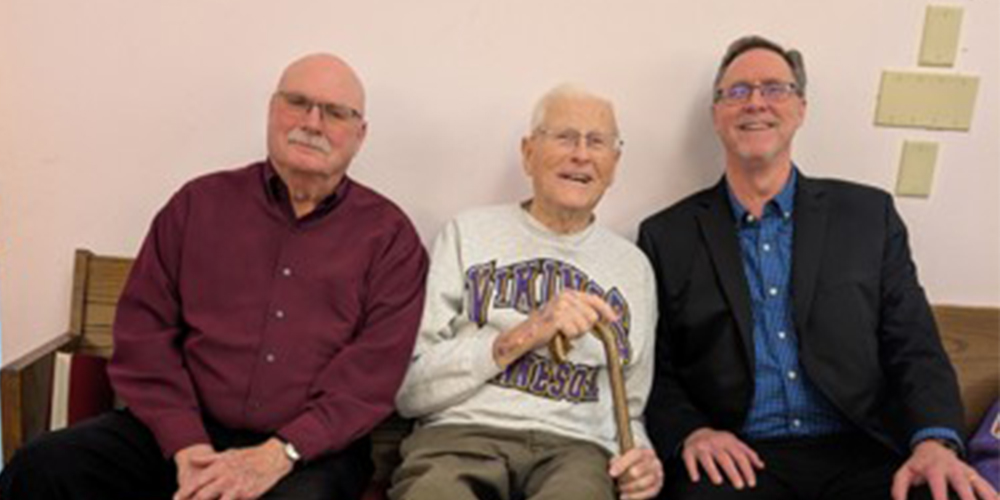
These two men understand the generous grace of Jesus. They have extended this same generous grace to others, and it overflows in even more gratitude and grace.
This is countercultural to the toxicity that exists in so many places, even in the church at times.
Mercy Now
While streaming music one day, I heard a song by singer-songwriter Mary Gauthier for the first time.
Gauthier is not known as a Christian singer, but each verse of her song “Mercy Now” begins by naming a person or group that “could use some mercy now.” Two verses that stand out to me read like this:
My brother could use a little mercy now.
He’s a stranger to freedom.
He’s shackled to his fear and his doubt.
The pain that he lives in, it’s almost more than living will allow.
I love my brother; he could use some mercy now.
My church and my country could use a little mercy now.
As they sink into a poisoned pit, it’s going to take forever to climb out.
They carry the weight of the faithful who follow them down.
I love my church and country.
They could use some mercy now.
The song concludes, “Every single one of us could use some mercy now.”
Sowing Seeds
What might happen if our churches determined to sow seeds of generosity, like fields of sunflowers?
What if our churches became unified fields facing the Son, shining bright, and willing to take on the toxicity of the world around us, by the power of the Spirit, and in the grace of Jesus?
It will cost us. It will require humility, radical hospitality, willingness to listen to the ranting and pain of those around us, and loving those who don’t expect to be loved.
_
“What might happen if our churches determined to sow seeds of generosity, like fields of sunflowers?”
But what might this do to create renewed soil for a Spirit-fueled movement of God?
What would it look like if we created a culture of generosity in our churches and neighborhoods? May it be so.
“But to you who are listening I say: Love your enemies, do good to those who hate you, bless those who curse you, pray for those who mistreat you. If someone slaps you on one cheek, turn to them the other also. If someone takes your coat, do not withhold your shirt from them. Give to everyone who asks you, and if anyone takes what belongs to you, do not demand it back. Do to others as you would have them do to you.
“If you love those who love you, what credit is that to you? Even sinners love those who love them. And if you do good to those who are good to you, what credit is that to you? Even sinners do that. And if you lend to those from whom you expect repayment, what credit is that to you? Even sinners lend to sinners, expecting to be repaid in full. But love your enemies, do good to them, and lend to them without expecting to get anything back. Then your reward will be great, and you will be children of the Most High, because he is kind to the ungrateful and wicked. Be merciful, just as your Father is merciful.” (Luke 6:27–36)
+

Carl Brannon has served as the superintendent of the North Central Conference since 2020. He has had a variety of leadership roles and experiences during his years in ministry, which include pastoring in the North Central Conference and as staff pastor at the Greenville Free Methodist Church for 13 years. He is a strategic thinker with multiple experiences in cross-cultural collaboration and outreach, as well as a passion to grow the kingdom through developing and multiplying leaders. This article is adapted from a devotional message he shared last month during Superintendent Leadership Team meetings in Indianapolis.
Great Writing + Discipleship Materials