
By Bishop Kaye Kolde
In the period between Easter and Pentecost, the church has historically celebrated the Resurrection while at the same time waiting expectantly for Pentecost. I have been spending these last several weeks meditating on the coming of the Holy Spirit in power upon those who were obediently waiting and praying in an upper room in Jerusalem.
At the same time, I am hearing women lament new and different kinds of attacks on their full participation, side by side with men, in the life and ministry of the church. The birth of the church, however, gives us a picture of the full inclusion of women who would seek to fulfill Jesus’ word in obedience with their brothers.
_
“The birth of the church gives us a picture of the full inclusion of women who would seek to fulfill Jesus’ word in obedience with their brothers.”
After Christ’s ascension in Acts 1, “the apostles returned to Jerusalem from the hill called the Mount of Olives, a Sabbath day’s walk from the city. When they arrived, they went upstairs to the room where they were staying. Those present were Peter, John, James and Andrew; Philip and Thomas, Bartholomew and Matthew; James son of Alphaeus and Simon the Zealot, and Judas son of James. They all joined together constantly in prayer, along with the women and Mary the mother of Jesus, and with his brothers.” (Acts 1:12–14)
It is notable that in this room where they were staying were the remaining apostles, “along with the women,” gathered together to obediently wait and pray. There is ample evidence from Jewish writings and archaeology that men and women were accustomed to praying together in the synagogues, yet here in Jerusalem, where the second Temple was the center of their worship, women were segregated from the inner parts of the Temple courts.
The Court of Women was considered a middle court, and as far into the Temple as women and Gentiles could enter. The historian Josephus described it as a place where the sexes could mix (Josephus, “The War of the Jews”), but women could not pass beyond into the inner courts where only ritually pure Jewish men could enter.
That is until Pentecost enabled all believers to have direct access to worship God in Spirit and in truth, as Jesus told the Samaritan woman at the well (John 4:23–24).
Becoming the Temple Together
I recently spoke with a woman at a Free Methodist gathering and heard some of her story. For years she had fully participated, at least to the extent she was permitted, in the life of a church in another tradition with all male leadership. She explained that women were not allowed to receive Communion, but had to be served by their husbands. She was permitted to offer a ministry that required specialized training, but it had to be run by the men of the church. She was not permitted, however, to have her own conviction from God’s Spirit about a situation related to that ministry and was abruptly told to submit or pack up her things.
_
“Pentecost enabled all believers to have direct access to worship God in Spirit and in truth, as Jesus told the Samaritan woman at the well (John 4:23–24).”
After visiting several theologically similar churches in her area, she could only attribute it to the Holy Spirit when another church in her community was highlighted to her and her husband — what turned out to be a Free Methodist Church.
As I look at the story of Acts 1 and 2, I am simultaneously grieved that her prior church experience limited the power and presence of the Holy Spirit in and through her, and thankful that she has a testimony that now includes a fuller expression of Pentecost in her and His church. Because of Pentecost, she — like countless other women and Gentiles or people deemed unclean for various reasons — has been able to not just pass into, but dwell, in the very presence of God. We have by faith been filled with the Holy Spirit, the very presence of God, to become the temple of God together.
The Same Spirit
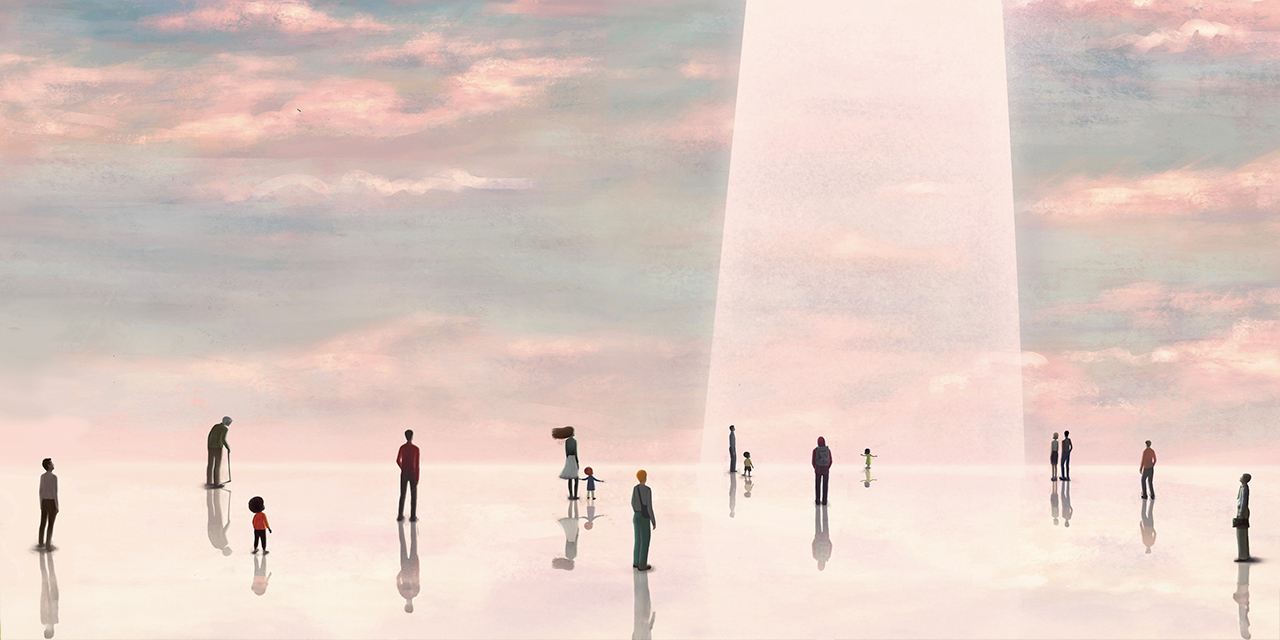
When Peter first stood to address the 120 believers expectantly praying in Acts 1:15, he began by saying, “brothers and sisters,” in the NIV version. It is a small detail that represents a translation choice made because God’s family, adelphoi in Koine Greek, includes male and female, created in His image. Luke records in chapter 2 that all together in one place tongues of fire came to rest on each of them — each brother and each sister filled with the same Spirit that birthed the church.
_
“We have by faith been filled with the Holy Spirit, the very presence of God, to become the temple of God together.”
Every believer was now given the same access to the Holy of Holies and the mercy seat of God by our great High Priest, Jesus. Every believer, each one, was given the manifestation of the Spirit for the common good (1 Corinthians 12:7), distributed as the Spirit determines (1 Corinthians 12:11). When Peter addresses the larger crowd of witnesses to this miraculous infilling of God’s Spirit in Acts 2, inspired by the Spirit, he quotes the prophet Joel:
“In the last days, God says, I will pour out my Spirit on all people. Your sons and daughters will prophesy, your young men will see visions, your old men will dream dreams. Even on my servants, both men and women, I will pour out my Spirit in those days, and they will prophesy.” (Acts 2:17–18)
Sons and daughters would both receive gifts and use them for the sake of His church.
Creating Boundaries or Building Up?
I wonder, how often do our churches still create boundaries in worship and service that have been removed in Christ? Together, side by side, we are living stones building up the temple of God, because we are not just filled with His Spirit individually, but collectively. All who were kept out have been invited in by grace through faith, and only together are we built up into the whole measure of the fullness of Christ (Ephesians 4:13).
_
“Together, side by side, we are living stones building up the temple of God, because we are not just filled with His Spirit individually, but collectively.”
May your celebration of Pentecost be joyous and ongoing as we obediently pray and seek to do His will together in our day, side by side as brothers and sisters.
+

Great Writing + Discipleship Materials