By Michael McAvoy
But he said to me, “My grace is sufficient for you, for my power is made perfect in weakness.” Therefore I will boast all the more gladly about my weaknesses, so that Christ’s power may rest on me. That is why, for Christ’s sake, I delight in weaknesses, in insults, in hardships, in persecutions, in difficulties. For when I am weak, then I am strong. (2 Corinthians 12:9–10)
In 1984, Dry Idea deodorant launched a marketing campaign with the slogan, “Never let them see you sweat.” While a great way to sell deodorant, it fueled a longtime misunderstanding and mistake about strong leadership.
The false view was that the best leaders were never vulnerable and never revealed fear, weakness, or failure. So leader after leader spends a lot of time, energy, and money to build and maintain the facade, a pretense, a false self that looks differently than what is really going on inside. I can tell you from experience that a facade or pretense will be a prison. The longer and bigger the facade, the stronger and bigger the prison.
Jesus had another word for facade, hypocrite (to wear a mask, to pretend), and He had a different standard and expectation of leadership. Rather than pretending to know it all, do it all, be it all, have it all together, and the like, His approach was to be authentic and real about all of it.
_
“I can tell you from experience that a facade or pretense will be a prison.”
Golden Joinery
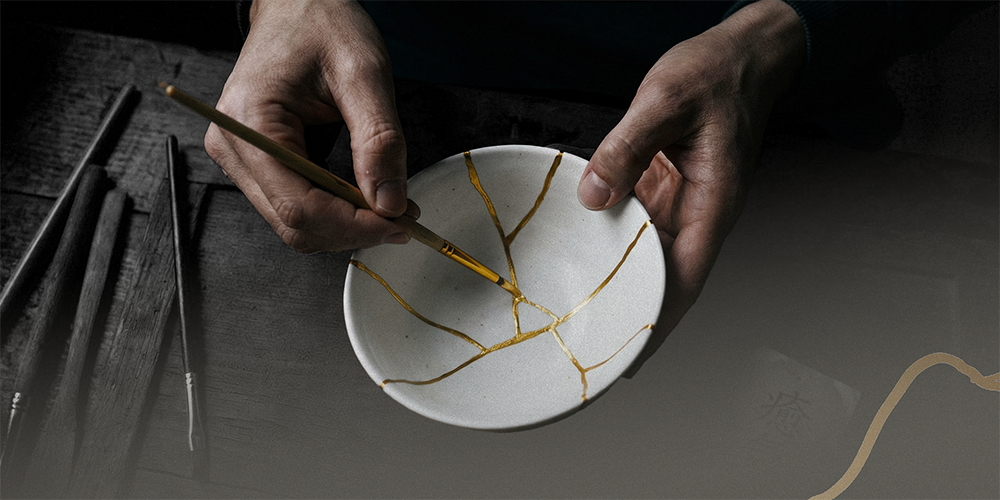
We could call this approach “kintsugi leadership.” Kintsugi is a Japanese word meaning “golden joinery.” It is a 15th century Japanese art form that repairs broken pottery.
Instead of hiding brokenness and damage, this technique actually highlights fractures, embracing flaws as part of the object’s story and beauty. It symbolizes resilience — turning broken, discarded items into unique, stronger pieces, and finding beauty (good) in the brokenness and imperfection.
Did you ever notice how Scripture unashamedly records the ugliest parts of people’s lives and doesn’t try to cover them up or make light of them? (Many times, I wish it would.)
Here are two things to note about Kintsugi:
1) Kintsugi is a process. It takes time, intentionality, humility, vulnerability, hard work, and allowing the Holy Spirit to speak, touch, make visible, and work in those broken, cracked places of our lives.
2) The cracks and brokenness are only beautiful when they are filled with the glory of the Spirit of God working in and restoring them. The glory isn’t the crack, or the broken vessel, but that which brings it all back together, heals, restores, makes strong, and shines through. Both of these require a willingness to be exposed, which can be very painful at first.
_
“Did you ever notice how Scripture unashamedly records the ugliest parts of people’s lives and doesn’t try to cover them up or make light of them?”
By God’s Grace and Power
While the people of this world spend all their time, energy, and money trying to hide their weaknesses, imperfections, failures, and shortcomings — trying to impress everyone with how great they are — the healthiest, strongest, and best leaders acknowledge (and even brag) on them so that the strength and accomplishments revealed through them are recognized for what they are: the work of God and His greatness, not their own greatness.
Don’t confuse this with delighting in sin. No! This is delighting in the sufficiency of God’s grace and power at work in our lives in the midst of all our limitations, weaknesses, and failures to do immeasurably, abundantly, above, and beyond all that we could ask, think, or imagine.
With this in mind, we must ask ourselves:
- What areas have you been trying to hide or make look better than they really are?
- What has held you back from being open and honest about your struggles?
- What are the steps Scripture gives to address these issues to work toward restoration in those areas of your life?
- What is the Spirit saying and wanting to do in these areas?
- With whom are you able to be open and honest to acknowledge/confess and receive accountability to address these issues?
Let’s follow the examples of Peter and Paul who — though they were weak, cracked, and broken — were restored and made whole and strong by the Holy Spirit. Not in such a way to hide all their weaknesses and brokenness, but rather to reveal His glory through them.
_
“What areas have you been trying to hide or make look better than they really are?”
Are we ready and willing? It can be scary and painful, but the other side of it is freedom, strength, and victory.
+

Great Writing + Discipleship Materials